

Hear me out on this one. Just hours after my initial session with FBC: Firebreak, I was enjoying a delicious cream cake when disaster struck. Being somewhat clumsy, I managed to drop a dollop of cream right into my blood orange cocktail. As I watched it swirl and dissolve, my mind instantly flashed back to the halls of the Federal Bureau of Control, firing searing liquid bursts at the glowing red enemies patrolling its corridors. It's exactly the kind of bizarre mental leap that a visit to Remedy's universe inspires.
Remedy’s portfolio is wonderfully diverse, spanning horror, sci-fi, and neo-noir detective stories. Yet, what I've always admired about the studio behind Alan Wake and Max Payne is its fearless embrace of the absurd. Firebreak, their newest project and first venture into both first-person shooting and cooperative multiplayer, is extremely silly. During my two-hour play session, I annihilated everything in my path with a homicidal garden gnome and battled a 30-foot-tall sticky note behemoth. These moments convinced me that if any developer can make a splash in the crowded, often overly serious online shooter market, it's Remedy, with its distinctive flair for injecting the bizarre into all its creations.
FBC: Firebreak - Gameplay Screenshots
View 16 Images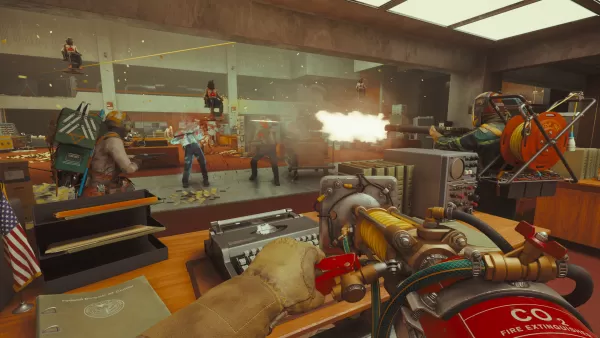
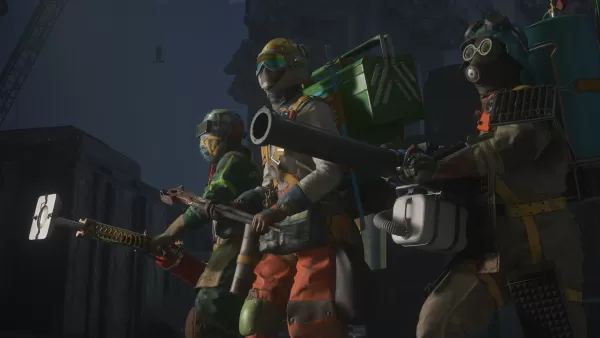
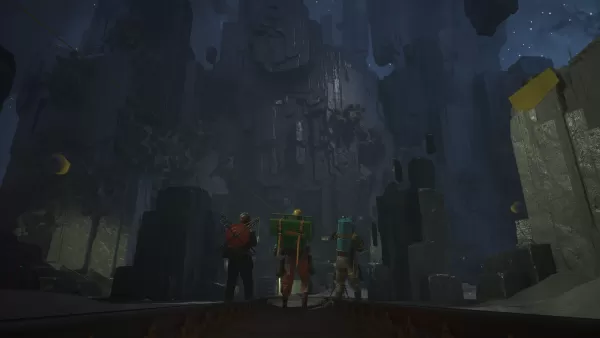
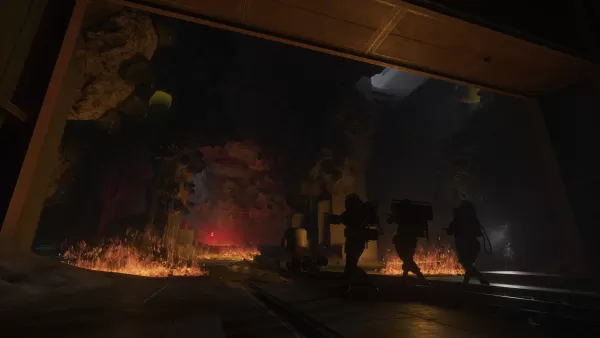
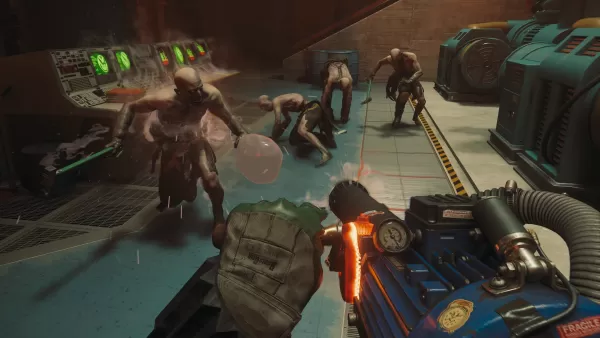
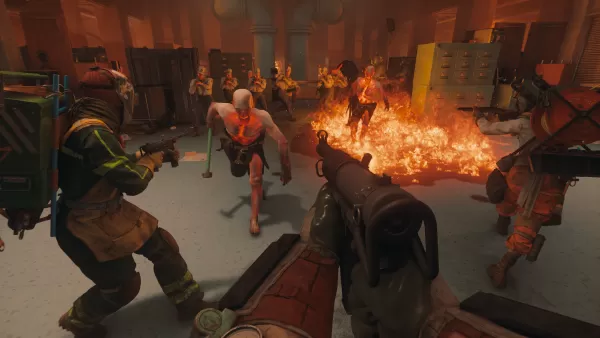
Set six years after the events of Remedy’s 2019 hit, Control, Firebreak returns to The Oldest House, a location familiar to fans of Jesse Faden’s story. Both the overarching aesthetic and minute details remain intact, from the imposing brutalist architecture to the unexpected Finnish folk music drifting from bathroom speakers, creating a comforting yet slightly unnerving homecoming. In Firebreak, squads re-enter this X-Files-esque government building to contain localized outbreaks of the Hiss, the interdimensional threat from Control that possesses both living and inanimate entities. You and up to two teammates are essentially this world's Ghostbusters, armed with double-barreled shotguns instead of proton packs. The key difference? Crossing the streams is not just allowed—it’s encouraged.
Here's how it works. Alongside conventional firearms like pistols and rifles, you choose from three distinct "kits." These function as Firebreak’s classes, each providing unique offensive and defensive support. The Fix Kit, for instance, lets you quickly repair essential machinery like ammo stations and healing showers (yes, FBC agents restore their health by standing under a waterfall—I did mention the silliness). The Splash Kit equips you with a hydro cannon that can replenish teammates' health or soak enemies. Meanwhile, the Jump Kit features a short-range Electro-Kinetic Charge Impactor that stuns foes. While each kit is effective on its own, combining them unleashes devastating results. You can probably imagine what happens when you electrify a group of drenched enemies.
Although the game is fully playable solo, its design clearly emphasizes three-player cooperation.
Teamwork and communication are essential in Firebreak. Even though you can tackle the entire experience alone, the game is built for a trio, especially when the action intensifies. Every mission (or "job") in FBC: Firebreak follows the same basic structure: infiltrate an area, complete your objectives, and then retreat to the elevator you arrived in. My first assignment was straightforward: repair three malfunctioning heat fans in the building’s furnace while fending off enemy waves, then make a swift exit back to the elevator.
But as I mentioned, things can get chaotic. My next mission, "Paper Chase," was a completely different beast. It required destroying thousands of scattered sticky notes before we could advance. The challenge was twofold: regular Hiss ambushes disrupted our progress, and the notes themselves could latch onto us, inflicting damage. Never has the phrase "death by a thousand paper cuts" felt more literal. While a simple melee attack could destroy them, they were far more efficiently eliminated with a quick soak and an electric shock—another clever application of Firebreak’s elemental kit system. This cooperative synergy is backed by responsive gunplay, ensuring you always have options even without direct team support. I quickly gravitated toward the machine gun, relishing the satisfaction of mowing down glowing red apparitions that burst into the familiar oily haze seen in Control.
The third mission, set in The Oldest House’s Black Rock Quarry, demanded the most coordination. Shooting pulsating leeches from the cavern walls yielded lethal radioactive pearls that needed to be secured in a shuttle. Once contained, these pearls were transported along a track to deeper quarry zones. This was the most demanding mission, highlighting the importance of clear communication. Constant interruptions—radiation requiring frequent decontamination showers, relentless enemy swarms, and instant-kill astral spike entities—continuously hampered our advancement. Despite the frequent chaos, I still had a great time.
While I appreciated the mission objectives, I have mixed feelings about Firebreak’s map design. In Control, The Oldest House was a devious, shape-shifting maze full of secrets. Here, the layouts are more straightforward. This is likely a practical choice, as tighter, more linear spaces are easier to navigate in first-person (even without a minimap, my team and I occasionally got lost in these compact areas). However, I can't help but feel the Federal Bureau of Control’s headquarters has lost a bit of its unpredictable charm. Don't expect anything as wondrous as the Ashtray Maze, for example. Instead, you'll explore simpler, more grounded environments.
These missions might sound simple, but upon completion, you unlock higher clearance levels for each, introducing new objectives and extending their duration. Revisiting maps reveals expanded areas with additional chambers, more complex goals, and tougher enemies. Like in Control, boss encounters block progress in certain zones, initiating lockdowns. These range from bullet sponges with massive health pools to more inventive foes, like a colossal sticky note monster that pummeled my team with its enormous yellow fists. The latter was far more engaging, requiring the communication and teamwork I value in co-op shooters. Part puzzle, part damage race, it evoked the final stages of some Space Marine 2 expeditions, where brute force must occasionally yield to thoughtful strategy.
Monsters crafted from ordinary objects were a highlight of Control for me, so I'm thrilled to see that signature weirdness carry over. This extends to randomly spawning corrupted items. Sadly, I didn't encounter any during my session, but the potential is exciting (a rubber duck designed to draw all enemy aggro, allowing teammates to focus on objectives, did spawn, but its small size made it impossible to find—a readability issue the dev team confirmed they're addressing before launch). Another item described to me was a massive traffic light; getting caught in its red beam inflicts significant damage, injecting a dash of Squid Game tension into the otherwise grey brutalist setting.
There are strong fundamentals here, though my primary reservations center on readability.
It's these signature Remedy touches that give Firebreak its unique identity. This creativity extends to your loadouts; mission completions grant unlock tokens used to acquire delightfully eccentric gear. This includes ultimate abilities like the Splash Kit’s Teapot, which scalds any enemy hit by its superheated droplets. Then there's the Jump Kit’s unpredictable garden gnome, summoning a destructive electrical storm within its radius. This ability, in particular, frequently turned my sessions with Firebreak into glorious, chaotic scrambles. Most of the time, it's a blast, juggling abilities to decimate enemy hordes. Occasionally, however, the screen becomes so crowded with effects that it's difficult to decipher what's happening.
There are strong fundamentals here, though my primary reservations center on readability. Sometimes the path forward on a map is unclear. Other times, it's challenging to avoid friendly fire or identify the boss amidst a dense mob. There is simply a lot happening on screen, with vibrant effects popping everywhere, which can be overwhelming when trying to execute precise, tactical play. I've been assured the Firebreak team is well aware of this concern and plans to make significant improvements to the game's overall clarity before its June 17 launch.
Firebreak will launch with five jobs, with two more slated for release before the end of 2025. While that may not sound like a lot, game director Mike Kayatta describes them as "more like game modes" than standard missions. I understand that perspective; each job offers considerable replayability and depth thanks to multiple clearance levels and evolving objectives. Combined with its price point of $39.99 / €39.99 / £32.99 (and its inclusion on both Game Pass and PlayStation Plus), I believe there's more than enough content here to keep both Control veterans and newcomers seeking a fun co-op shooter engaged for many hours.
The always-online co-op shooter path is a challenging one for any developer today. Yet, after my time with Firebreak, I'm confident a solid foundation exists. Infused with Remedy’s trademark quirky personality, I believe it can carve out its own unique space. Much like that dollop of cream found its place in my cocktail. And yes, I still drank every last drop.
 Latest Downloads
 Downlaod



 Top News